


Welcome to our fifth feature in our Meet the Changemakers series - a weekly look into the steps young leaders are taking to turn bold ideas into necessary change in their communities. Now more than ever, it is important to learn from the young leaders across the country who are dedicated to tackling the most challenging issues of our time.
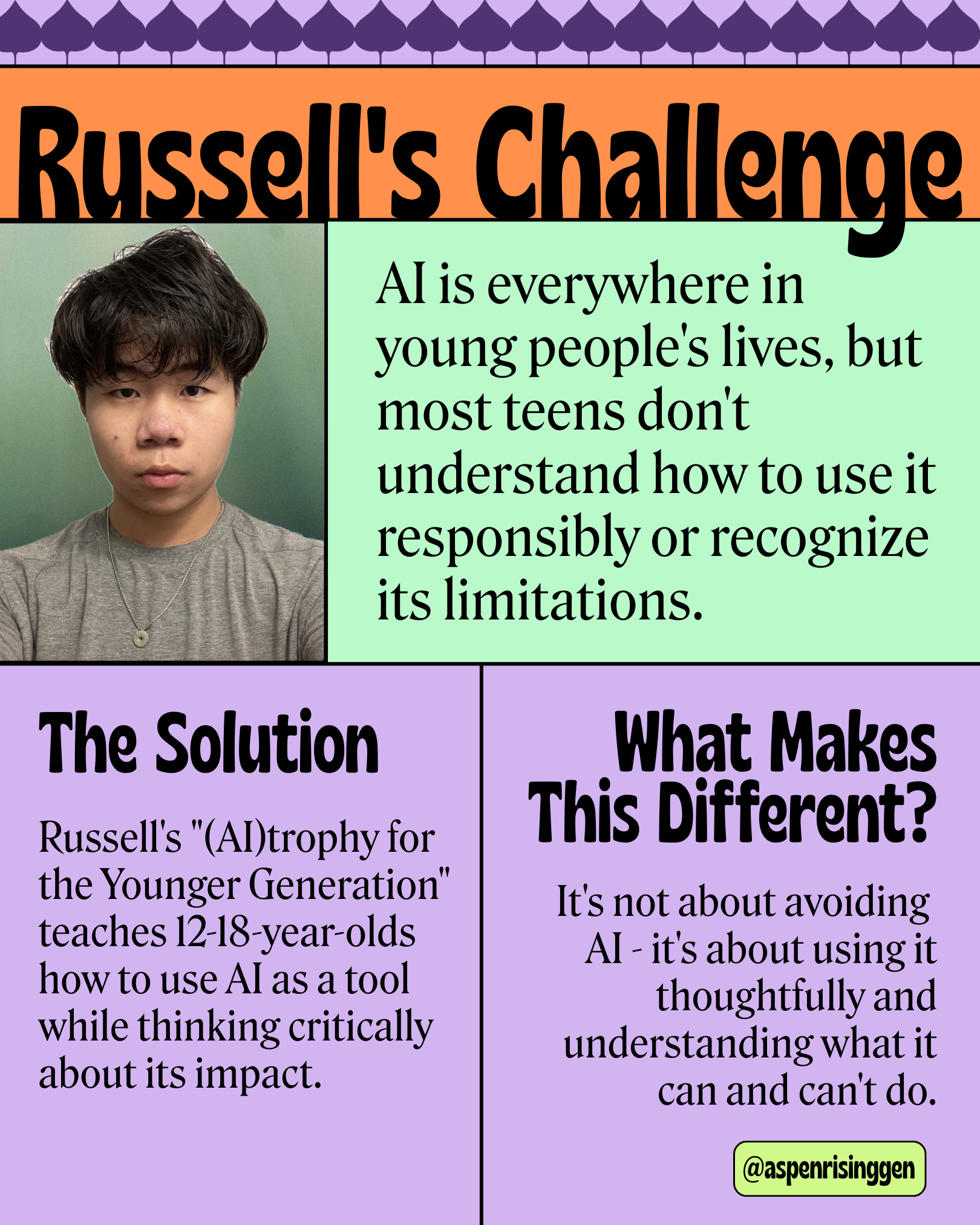
We are excited to feature Russell Zhang, a first-generation, junior in high school in New York City. Russell has developed a project called (AI)trophy For The Younger Generation, focusing on the urgent need to provide education about generative AI, and the vast opportunities it may have for underrepresented individuals if used safely. With the emergence of Big Tech and Big AI, Russell is not shying away from one of the world’s most pressing issues — he’s tackling it head on.
Read, reflect, and join the conversation in the comments below. Let’s celebrate Russell and all of our other Changemakers and the powerful futures they’re already building.
In his own words…
My name is Russell Zhang, I’m a Junior attending Millennium High School in New York City. I’m a first generation student from immigrant parents. I love playing basketball with friends during my weekends, hiking through beautiful mountainous terrain, and playing the guitar.
My project is called (AI)trophy For The Younger Generation, a non-profit organization that gives the next generation the opportunity to understand how to use generative AI properly and how to leverage it to enhance their professional development, personal growth, and more. The organization intends to narrow the growing income tech literacy disparity by taking a chance on underprivileged young people and giving them an opportunity to learn and explore AI in a healthy way.
With the rapid introduction of Foundation Models like ChatGPT, young people who aren’t educated on AI believe it is sentient and that generated responses are fact. Ultimately kids today are growing up in an environment where critical thinking and problem-solving are often substituted with quick, AI-generated answers. The choice between taking hours to write out an essay or instantly generating a sophisticated response makes AI that much more enticing. With that, the ease of access to AI tools has led to a rise in academic dishonesty. Our organization believes that young people, especially from underprivileged communities, deserve the opportunity to understand and learn how to use AI and its dreams to democratize knowledge to anyone in the world.
Generative AI, Machine Learning, Deep Learning, Foundation Models — millions of kids including adults, do not understand what AI is, and how it functions. Imagine a tool that provides billions of people from all over the world the access of expert level first approximation to any question. Artificial intelligence provides the dream of democratized knowledge, no matter where you are, what you do, or what connections your family holds. Envision how this tool could change an underprivileged child’s world, they don’t need powerful connections to learn how to become a doctor, a pilot, or a lawyer. All they need to do is input a prompt and learn from it.
When I first used AI, I didn’t care about what it meant, it’s dream, I only saw it as a new cheating mechanism found by my peers. As I dove deeper into the intricacies of AI I saw the impact and came to realize its detriments in education within our generation today. Many students now struggle to complete assignments without relying on technology to do the thinking for them. I see numerous examples, even in my club, where kids rely on AI tools created by companies for children to cheat in their school work. I know that AI can be used for the opposite of dumbing down, and I know the opportunity it provides for millions of people. I’ve personally used it to upskill in cooking, investing, or even educating myself about the workforce. Everyday I see AI being alienated in educational settings, but, we can change the perspective on AI into someone good if we genuinely try to teach people what it is. There is a clear correlation between digital and AI literacy between wealthy and underserved communities.
Growing up myself, I’ve come to realize the significance of digital literacy, my family were immigrants who came to America looking for greater opportunities. They knew nothing about the computer as not only did they not go to high school, but we faced numerous financial difficulties so they didn’t have time to educate themselves about technology. I spent a lot of my childhood learning these things myself and helping my parents with emails and documents. Today, the same thing is occurring with Artificial Intelligence, the opportunities provided by AI can not only be given to well educated rich kids, but also underprivileged kids. Giving young people the opportunity I didn’t have, to guide them properly through Generative AI and open their perspectives towards new and fascinating technologies, pushes me to continue to turn it into a reality.
I want the next generation to understand how to use generative AI properly and how to leverage it to enhance their professional development, personal growth, and more. Nearly two-thirds of businesses say they’ve adopted the technology, and higher income amplifies AI usage rates. 74% of households earning $100,000+ annually use AI. However, only 53% of households earning under $50,000 utilize AI (Menlo Ventures). One half of lower income families don’t even use or are familiar with Large Language Models, not even taking into account the understanding of its dangers, benefits or how it works. This statistic also emphasizes that there is a clear relation between income-based AI literacy between wealthier and underprivileged households. It highlights the true scale of the rapid adoption of generative AI. Millions of underprivileged communities do not know what it is, how to properly utilize it as a tool, and how to maximize its promises to democratize knowledge to all people.
Furthermore, 85% of students (18 and older) report using AI the highest rate of any group we measured, and around two-fifths (44%) of children actively engage with generative AI, with more than half (54%) using it for schoolwork and/or homework. Incidents of AI and cheating in schools were reported by around a quarter (24.11%) of charter high school students, compared to just 6.44% for private high schools and 15.2% for public institutions (Rutgers New Brunswick). Underprivileged kids are more prone to use GenAI irresponsibly as previously mentioned, half of my peers’ parents don’t even use it. I hope to narrow the growing income tech literacy disparity with my organization by taking a chance on underprivileged kids and giving them an opportunity to learn and explore AI correctly.
This program will show young people the dreams of AI. This program will shift their perspective on generative chatbots for the kids and young adults. Not as a metric for cheating, but as a tool that supports thinking, not a replacement for it. And this program will make a change in our community, providing more opportunities to bridge the familiar income-based digital divide.
I’ve measured progress between 4 phases, currently I’ve developed a website and my curriculum and I am heading into phase 2. I’ve partnered with Millennium High School and Lower Manhattan Community Middle school and I am getting ready to pilot my workshops.
In the next 6 to 12 months I hope to have developed extensive partnerships with organizations, public schools, libraries, and the New York City Department of Education to bring this opportunity to every single kid in New York. I also hope to successfully host multiple workshops across the district and completely finish developing my curriculum. My website will be up and make my curriculum readily accessible to anyone in the world who is curious, wants to educate others, and learn about the goals (AI)trophy intends to facilitate within our communities.
I am incredibly thankful to the Aspen Institute for the 5,000 dollar grant and their support for my dream to make this project into a reality. Junior year has been really busy and time consuming due to upcoming exams and AP classes however, I’ve made time to work on this project whenever I’m available as it is extremely important to me. I would also like to thank my family and friends for their support.